Ford AI assistant and BlueCruise upgrades signal a major shift in how the automaker plans to blend software, autonomy, and everyday driving. At the 2026 Consumer Electronics Show, Ford quietly revealed plans that could redefine its digital and driver-assistance roadmap over the next several years. While many global automakers once dominated CES stages with bold unveilings, Ford chose a more restrained approach. Yet the implications of what it announced may be far more significant than the modest setting suggested.
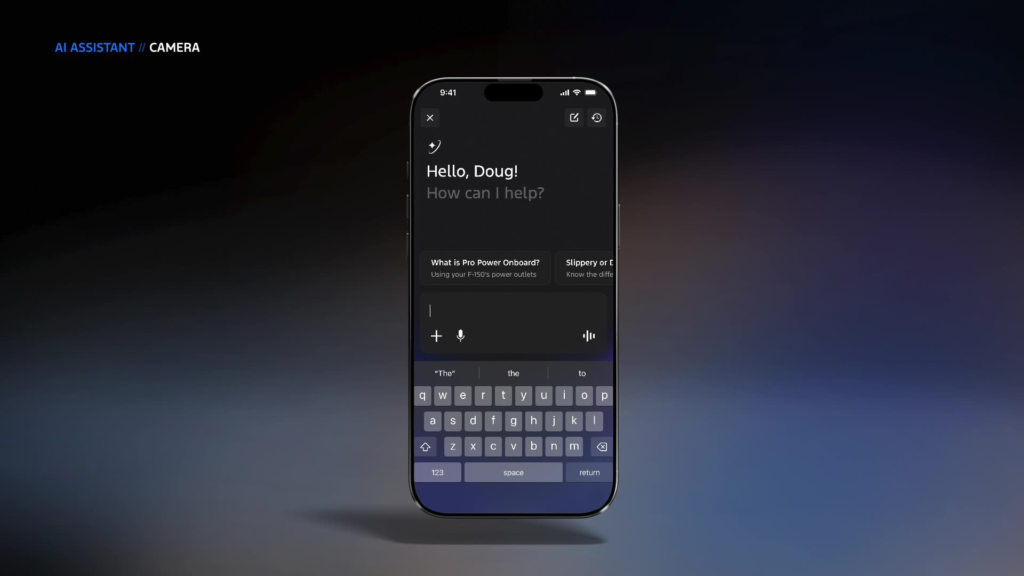
The company confirmed it is building a new AI assistant designed to live first inside its smartphone ecosystem. This assistant will roll out through Ford’s revamped mobile app in early 2026, before expanding into vehicles starting in 2027. The strategy reflects a clear focus on meeting customers where they already interact with the brand. By beginning on smartphones, Ford can refine the assistant’s intelligence, reliability, and usefulness long before it becomes a core in-car experience.
Ford’s AI assistant is hosted on Google Cloud and relies on off-the-shelf large language models rather than proprietary AI from scratch. That decision allows Ford to move faster while keeping costs under control. More importantly, the assistant will have deep access to vehicle-specific data. This means drivers will not only be able to ask general questions, but also receive precise, real-time answers based on their exact vehicle configuration.
Owners will be able to ask practical questions such as how much cargo a truck bed can safely carry or how many bags of mulch fit without exceeding limits. At the same time, the assistant will handle detailed operational queries like remaining oil life, maintenance needs, and vehicle health updates. This focus on useful, everyday information suggests Ford is prioritizing practical value over novelty.
While Ford has not fully detailed how the in-vehicle experience will look, the direction is clear. The assistant is intended to become a natural extension of the driving experience rather than a gimmick. Voice interaction, contextual awareness, and seamless integration with vehicle systems are all expected to play central roles once the assistant arrives in cars in 2027.
Competition in this space is already heating up. Rivian recently showcased its own digital assistant capable of sending and receiving messages, managing navigation with complex instructions, and adjusting climate controls through natural language. Tesla has gone even further by integrating Grok, an AI chatbot developed by xAI, allowing drivers to generate custom sightseeing tours and conversational responses while on the road.
These examples show how quickly in-car AI is evolving. Some features demonstrated by competitors may currently appear more advanced than what Ford has outlined. However, Ford’s later timeline also gives it room to observe real-world usage, refine safety boundaries, and avoid early missteps that could frustrate drivers. A full year of development before in-car deployment could prove to be an advantage rather than a delay.
Alongside the AI assistant, Ford teased a major evolution of its BlueCruise hands-free driving technology. The next-generation BlueCruise system is designed to be approximately 30 percent cheaper to produce while offering expanded capabilities. Cost reduction is critical as advanced driver assistance systems move from premium features to mainstream expectations.
This new BlueCruise version will debut in 2027 on the first electric vehicle built on Ford’s low-cost Universal Electric Vehicle platform. That vehicle is expected to be a mid-sized electric pickup, signaling Ford’s intent to bring advanced autonomy features to high-volume, practical models rather than limiting them to luxury segments.
Ford’s ambitions for BlueCruise extend well beyond incremental improvements. The company says the next iteration will eventually support eyes-off driving by 2028. This would mark a significant milestone, as eyes-off capability requires far higher confidence in system reliability, sensor coverage, and real-time decision-making.
Ford also claims the upcoming system will support point-to-point autonomy. This approach allows a vehicle to navigate from one location to another under driver supervision, similar in concept to Tesla’s Full Self-Driving Supervised software. Rivian has also hinted at launching a comparable system later this year, highlighting how competitive the space has become.
Despite the promise of point-to-point autonomy, Ford was careful to emphasize that drivers must remain ready to take control at all times. These systems are not fully autonomous and still depend on human oversight. That clarity is important as regulators, safety advocates, and consumers continue to scrutinize how autonomy is marketed and deployed.
The quieter nature of Ford’s CES appearance may actually reflect a broader shift in strategy. Rather than flashy demos, Ford appears focused on building scalable software platforms that can evolve over time. By combining an AI assistant that understands vehicles deeply with a more capable and affordable BlueCruise system, Ford is laying groundwork for a more software-defined future.
This approach aligns with changing consumer expectations. Drivers increasingly want vehicles that feel intelligent, responsive, and easy to manage. They want technology that solves real problems rather than creating distractions. Ford’s emphasis on practical AI assistance and incremental autonomy suggests it is listening closely to that demand.
If execution matches ambition, Ford’s AI assistant and next-generation BlueCruise could become defining features of its lineup later this decade. The coming years will reveal whether Ford can translate careful planning into everyday experiences that feel both advanced and trustworthy. What is clear is that Ford is no longer content to let software leadership belong solely to newer electric-only rivals.