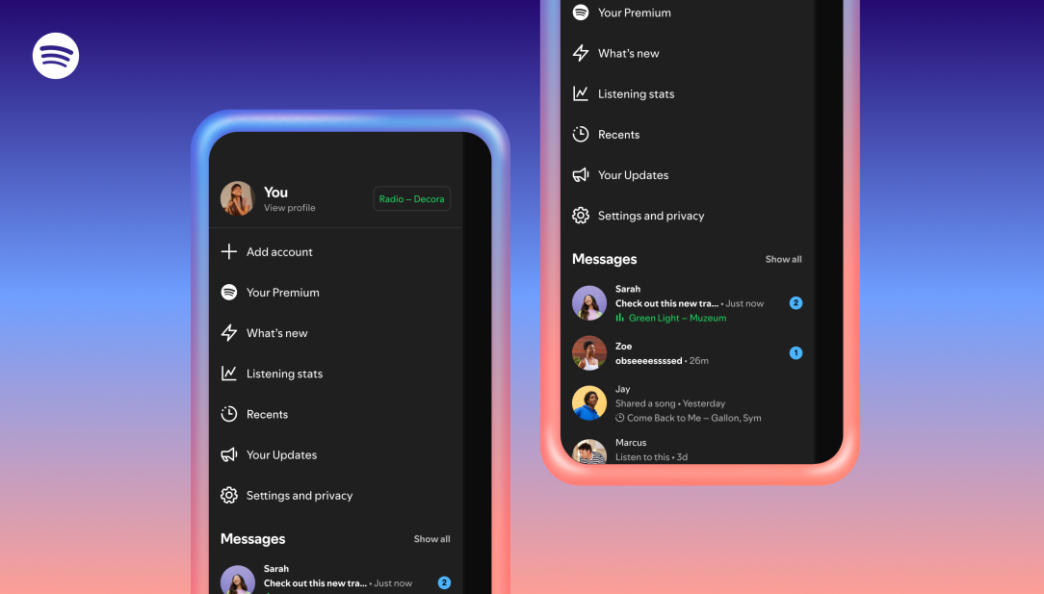
Spotify listening activity sharing is taking a major step forward as the streaming giant deepens its push into real-time social music experiences. The company has rolled out a new Messages update that allows users to share what they are streaming live with friends, all without leaving the app. This move strengthens Spotify’s effort to keep conversations, discovery, and collaborative listening inside its own ecosystem instead of losing engagement to external social platforms.
Spotify listening activity sharing now appears directly inside Messages once users enable the feature. After turning on “listening activity” in the Privacy and Social section of Settings, a user’s current track shows at the top of individual message threads. Friends can instantly see what is playing and interact with it in several ways. They can tap to play the song, save it to their library, open the track menu, or react using emojis. This real-time visibility transforms Messages from a basic chat feature into a live music feed driven by social connection.
This update reflects a broader shift in how Spotify views its product. Music streaming is no longer just about passive listening. Instead, Spotify listening activity sharing turns music into a shared moment that evolves as friends listen, react, and respond in real time. The feature removes friction from music discovery by making recommendations feel personal and immediate rather than algorithmic and distant.
Spotify is also expanding the role of Jams, its collaborative listening feature, through Messages. Premium users can now send a Jam request directly from a chat using a dedicated button. When the recipient accepts, they become the Jam host, and both users can add tracks to a shared queue. This setup allows friends to listen together while contributing music dynamically, creating a social experience that feels closer to hanging out than simply pressing play.
Spotify listening activity sharing works alongside this Jam request system to make spontaneous listening sessions easier. Instead of sending links or screenshots through other apps, users can see what a friend is already enjoying and instantly join the vibe. This seamless transition from awareness to participation is a key part of Spotify’s strategy to boost in-app engagement.
Importantly, Spotify listening activity sharing is not limited only to paying users. Anyone with access to Messages can see friends’ listening activity once enabled. Free users can also join Jam sessions when invited by a Premium subscriber, which subtly encourages upgrades without locking social features entirely behind a paywall. This balance allows Spotify to expand social reach while still highlighting the added value of Premium.
The rollout is happening across both iOS and Android devices in markets where Messages is already available. Spotify says the features will be broadly accessible in these regions by early February. By tying listening activity and Jam requests directly to Messages, Spotify ensures that these tools feel integrated rather than bolted on.
Age restrictions also play a role in this release. Because Spotify listening activity sharing is built into Messages, the features are limited to users aged sixteen and older. This aligns with Spotify’s existing messaging policies and helps the company manage privacy and safety concerns as it leans further into social interaction.
Messages itself is still a relatively new feature on Spotify. The company introduced it in August twenty twenty-five as part of a wider effort to become more socially engaging. For years, users shared Spotify tracks, playlists, and podcasts through messaging apps and social networks outside the platform. While that behavior helped Spotify grow, it also meant that valuable engagement happened elsewhere.
Spotify listening activity sharing signals a clear shift in priorities. By encouraging users to talk, react, and listen together inside the app, Spotify gains more insight into social behavior while strengthening retention. Every interaction that stays within Spotify increases the chances that users will return more often and spend more time listening.
There are still limitations to Messages that shape how Spotify listening activity sharing works today. Messages are restricted to one-to-one conversations rather than group chats. Users can also only message people they have previously interacted with through shared playlists, Jams, or Blends. This keeps the feature controlled and intentional, though it may limit broader social discovery for now.
From a privacy perspective, Spotify notes that Messages are encrypted at rest and in transit. However, they are not protected by end-to-end encryption. Spotify listening activity sharing therefore operates within a system designed for convenience and safety, but not maximum privacy. For most users, the trade-off is likely acceptable given the casual nature of music sharing.
The bigger picture shows Spotify steadily repositioning itself as a social audio platform rather than just a streaming service. Spotify listening activity sharing turns passive consumption into a visible, interactive signal. Friends influence friends in real time, which can drive discovery more effectively than playlists alone.
This approach also helps Spotify compete more directly with short-form video and social platforms that dominate attention. By making music a shared experience inside its own app, Spotify reduces the need for users to switch contexts. That stickiness is crucial in an environment where every app is fighting to become the place where conversations happen.
Spotify listening activity sharing also benefits artists and creators. When users see what friends are playing live, songs gain organic exposure through trusted social circles. This kind of discovery often feels more authentic than algorithmic recommendations, which can increase saves, streams, and long-term fan engagement.
Over time, Spotify listening activity sharing could evolve into richer social layers. Group chats, expanded Jam sessions, and deeper reactions could follow as Spotify tests how users respond. For now, the feature represents a meaningful step toward keeping music social without overwhelming the listening experience.
Spotify’s decision to focus on Messages as the hub for these tools is strategic. Messages already connects users who share musical context. Adding real-time listening activity and Jam requests builds on that foundation without forcing users to rebuild social graphs from scratch.
As Spotify continues to invest in social features, listening activity sharing may become a core part of how people discover and enjoy music together. The update shows that Spotify is not just reacting to trends but actively shaping how social listening can work at scale.
For users, the change is simple yet powerful. Turning on Spotify listening activity sharing opens a window into friends’ musical worlds. With one tap, a song becomes a shared moment. That immediacy could redefine how people connect through music inside the app.