Bill Gates-backed fusion power startup Type One Energy has secured $87 million in new funding as it prepares for a much larger capital raise that could reshape the future of clean electricity. The financing arrives at a critical moment for the energy sector, as global power demand accelerates and pressure mounts to find scalable alternatives to fossil fuels.
The latest $87 million injection comes in the form of a convertible note and pushes total venture funding in Type One Energy beyond $160 million. Sources familiar with the transaction say the company is also actively raising a $250 million Series B round at a pre-money valuation of roughly $900 million. The company later confirmed the fundraising effort, signaling strong investor confidence in its long-term fusion strategy.
Type One Energy has emerged as a serious contender in the race to commercialize fusion power, a technology long viewed as the holy grail of clean energy. Fusion promises vast amounts of electricity using fuel sources that are abundant and virtually inexhaustible. Unlike traditional nuclear power, fusion avoids the long-lived radioactive waste and catastrophic failure risks that have fueled decades of public concern.
Rising electricity demand has strengthened the case for fusion startups like Type One Energy. Data centers, driven by artificial intelligence workloads and cloud computing, are projected to consume nearly three times more electricity by 2035. At the same time, electrification across transportation, manufacturing, and heating is pushing overall power demand higher year after year. Utilities and governments now face mounting pressure to secure reliable, carbon-free baseload energy.
Fusion power works by forcing atoms together at extreme temperatures until they fuse, releasing massive amounts of energy. That heat is then converted into electricity by spinning turbines, much like today’s coal or gas plants, but without emitting carbon dioxide or other pollutants. If scaled successfully, fusion could deliver gigawatts of clean power with minimal environmental impact.
One of fusion’s biggest advantages lies in safety. Fusion reactors do not rely on chain reactions, which means they cannot spiral out of control in the way fission reactors can. They also produce only trace amounts of short-lived radioactive material, dramatically reducing long-term waste management challenges. These characteristics make fusion an attractive option for regulators and communities alike.
There are two primary approaches competing within the fusion industry. Inertial confinement fusion compresses tiny fuel pellets using powerful lasers until fusion occurs. Magnetic confinement fusion, on the other hand, uses magnetic fields to control superheated plasma long enough for atoms to fuse. Type One Energy has chosen the magnetic confinement path and is betting on a specialized design known as the stellarator.
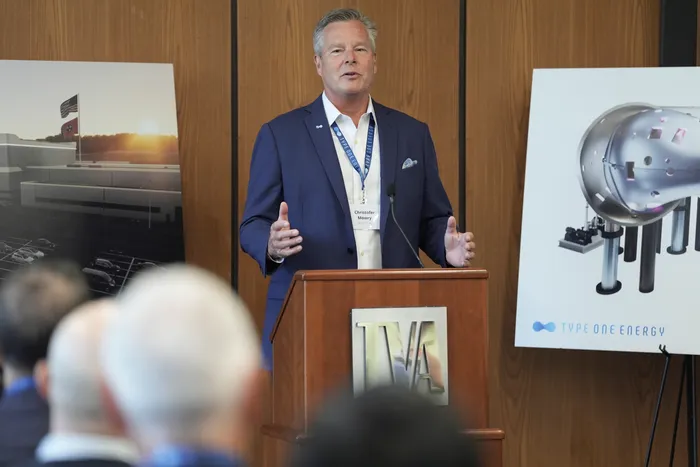
A stellarator uses a complex arrangement of magnets shaped into a twisted, doughnut-like structure. This geometry allows the plasma to remain stable over longer periods compared to other magnetic designs. While stellarators have demonstrated impressive plasma control in research settings, none have yet been built specifically to generate commercial electricity. Type One Energy aims to change that.
The company’s first commercial project, called Infinity Two, represents a major milestone for the fusion sector. Last year, Type One Energy signed agreements with the Tennessee Valley Authority to locate the facility at the site of the former Bull Run Fossil Plant, a coal-fired power station retired in 2023. The move reflects a broader trend of repurposing legacy fossil fuel sites for next-generation clean energy.
Infinity Two is expected to generate roughly 350 megawatts of electricity once operational. That output would place it firmly within the range of conventional power plants, making fusion a realistic contributor to regional grids. Type One Energy has said the plant could come online in the mid-2030s, aligning with growing forecasts for energy shortages later in the decade.
Unlike many startups in the fusion space, Type One Energy is pursuing a licensing-focused business model. Rather than building, owning, and operating power plants itself, the company plans to sell its core fusion technology to utilities and power providers. Those partners would then handle construction, ownership, and long-term operation of the facilities.
This approach could accelerate adoption by reducing capital risk for Type One Energy while allowing established utilities to leverage their existing expertise in grid operations. It also aligns well with organizations like the Tennessee Valley Authority, which already manage large-scale infrastructure and regional power distribution.
The company’s investor base underscores its credibility. Type One Energy previously raised a $29 million seed round in 2023, which later expanded to $82.5 million by 2024. Backers included Breakthrough Energy Ventures, the climate-focused investment firm backed by Bill Gates, along with Doral Energy Tech Ventures and TDK Ventures.
Bill Gates has long championed fusion as a critical tool in the fight against climate change. Through Breakthrough Energy Ventures, he has supported a range of advanced energy technologies that face long development timelines but offer transformative potential. Type One Energy fits squarely within that vision.
The fresh $87 million funding gives the company additional runway as it refines its stellarator design, advances regulatory discussions, and deepens partnerships with utilities. It also strengthens Type One Energy’s position as it negotiates the much larger Series B round, which would rank among the biggest private financings in the fusion industry to date.
Investor interest in fusion has surged in recent years, driven by technical breakthroughs, rising energy demand, and growing skepticism that renewables alone can meet future baseload needs. While fusion remains technically challenging, momentum is clearly building as capital flows toward companies with credible paths to commercialization.
Type One Energy’s strategy reflects a broader shift in how fusion startups are positioning themselves. Rather than selling power directly, many are focusing on becoming technology suppliers to utilities. This model mirrors the structure of today’s energy industry and may ease integration into existing regulatory and market frameworks.
If successful, Infinity Two could serve as a blueprint for future fusion deployments worldwide. Repurposing retired fossil fuel sites could reduce permitting hurdles, leverage existing transmission infrastructure, and speed up construction timelines. For regions facing plant closures and job losses, fusion could also offer economic revitalization.
Despite the optimism, challenges remain. Fusion systems must operate reliably for long periods, withstand extreme temperatures, and achieve favorable economics compared to other energy sources. Type One Energy will need to prove that its stellarator design can meet these demands at scale.
Still, the company’s progress highlights how quickly fusion is moving from theoretical promise toward commercial reality. With deep-pocketed investors, strategic utility partners, and a clear go-to-market plan, Type One Energy is positioning itself at the forefront of the next energy revolution.
As global electricity demand continues to climb and pressure mounts to decarbonize power grids, fusion power may finally be approaching its long-awaited breakthrough moment. Type One Energy’s latest funding round suggests that investors are increasingly willing to bet that the future of clean energy will be powered by the stars.