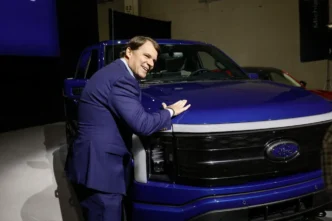

Ford F-150 Lightning is about to take a very different turn as Ford backs away from fully electric full size trucks and reshapes its entire EV strategy. The automaker has confirmed it will stop producing the all electric version of the F 150 Lightning and replace it with a new extended range electric truck that includes a gas powered generator to recharge the battery on the move.
The shift marks one of the clearest signs yet that Ford is retreating from its earlier bet on large electric vehicles. Instead of relying only on battery power, the next F 150 Lightning will blend electric driving with an onboard generator, allowing the truck to travel more than 700 miles without plugging in.
Ford has not shared a launch date or pricing details for the updated truck. Still, the message is clear. The company believes customers want flexibility, range confidence, and lower risk as EV adoption slows in key markets.
This change comes at a steep cost. Ford said it will take a $19.5 billion hit to overhaul its electric vehicle plans. A large portion of that includes an $8.5 billion writedown of EV assets that will be recorded in the fourth quarter. Another $5.5 billion in cash charges will be spread through 2027 as the company restructures production, supply chains, and product roadmaps.
The impact goes beyond accounting. Multiple factories and workers are affected by the shift. One of the biggest casualties is Ford’s next generation all electric truck, known internally as T3. That project is now canceled.
The T3 was meant to be a ground up electric truck design, unlike the original Lightning, which adapted electric components into a platform designed for gas engines. Ford confirmed it is also scrapping plans for a next generation electric commercial van. The existing E Transit will remain in production for now.
In a statement, Ford said it no longer plans to build certain large electric vehicles because demand came in lower than expected, costs remained high, and regulatory conditions changed. Together, those factors erased any clear path to profitability.
Despite the pullback, Ford is not abandoning electric vehicles entirely. The company confirmed it will still launch a midsize all electric pickup in 2027. That truck will sit on a new platform developed by a skunkworks team led by former Tesla executives Doug Field and Alan Clarke.
Ford expects that platform to support multiple future vehicles, giving the company more flexibility and lower costs than its earlier EV programs. The midsize truck will also benefit from a key battery shift.
Ford says it remains on track to begin producing lithium iron phosphate batteries in 2026 at the BlueOval Battery Park Michigan facility in Marshall. The technology is licensed from China’s CATL and is designed to lower battery costs while improving durability. These LFP batteries will be used in the upcoming midsize electric pickup.
Ford executives argue that the reset is about smarter capital allocation, not surrender. On a call with reporters, Ford president Andrew Frick said the company decided it made little sense to keep spending billions on large EVs with no profitability outlook.
Instead, Ford plans to redirect investment into areas with better returns. Those include hybrid trucks and vans, extended range electric vehicles, more affordable EVs, and new businesses such as energy storage.
The shift is a stark contrast to the optimism surrounding the Ford F 150 Lightning just a few years ago. Ford revealed the electric pickup in 2021, riding a wave of excitement sparked by Tesla and other EV makers. The Lightning followed Ford’s all electric Mustang Mach E and was positioned as a flagship for the company’s $22 billion EV push.
At launch, Ford teased a $40,000 starting price for the Lightning. That figure generated massive interest and helped the truck rack up reservations quickly. In practice, however, that price was mostly reserved for fleet buyers. Most retail customers faced much higher costs.
Like many large electric trucks, the Lightning struggled to gain sustained traction in the US market. Ford sold roughly 7,000 units per quarter over the past two years. The best quarter came in late 2024, when sales reached nearly 11,000 trucks.
Those numbers fell well short of early expectations. Heavy battery packs drove up costs. Pricing pressure squeezed margins. And consumer hesitation around charging, towing range, and resale value slowed adoption.
Broader market forces also played a role. Tesla launched aggressive price cuts across its lineup, triggering a price war that hurt legacy automakers already operating with thin or negative EV margins. At the same time, political winds shifted.
The reelection of Donald Trump and Republican control of Congress has led to the rollback of several Biden era policies designed to boost EV adoption. That includes changes to incentives, regulations, and emissions targets that once supported rapid EV expansion.
For Ford, the result is a strategic pivot toward pragmatism. The next Ford F 150 Lightning is no longer about proving electric trucks can replace gas vehicles outright. Instead, it is about meeting customers where they are.
By combining electric motors with a gas generator, Ford hopes to offer electric driving benefits without forcing buyers to rely entirely on charging infrastructure. The extended range setup aims to reduce anxiety, improve usability for long distance hauling, and appeal to traditional truck owners who remain skeptical of full electrification.
The move also signals a broader industry recalibration. Automakers are learning that EV transitions may take longer than expected, especially in segments like full size pickups. Hybrid and extended range designs may serve as a bridge rather than a final destination.
Ford’s decision underscores a simple reality. Technology alone does not drive adoption. Price, convenience, and trust matter just as much.
As the company reshapes its lineup, the Ford F 150 Lightning remains central to that lesson. The truck that once symbolized Ford’s electric future is now becoming a hybrid solution designed for a slower, more cautious road ahead.