MoEngage funding momentum is accelerating fast, and investors are doubling down on one of India’s most closely watched SaaS scaleups. Just weeks after securing $100 million, the customer engagement startup has pulled in another $180 million, pushing its valuation to well over $900 million and cementing its late-stage status.
The fresh Series F follow-on round landed barely a month after the earlier raise. This time, the structure mattered as much as the headline number. A large share of the capital went toward secondary transactions, giving early investors and employees a chance to cash out without forcing the company into a rushed public debut.
Of the $180 million raised, roughly $123 million came through secondary sales. That figure included a $15 million employee tender that provided liquidity to 259 current and former staff. The remaining $57 million flowed directly into the business as primary capital.
ChrysCapital and Dragon Funds led the round. Schroders Capital joined as a new participant, alongside existing backers TR Capital and B Capital. Several early investors used the opportunity to sell shares, including Eight Roads Ventures, Helion Venture Partners, Z47, and Ventureast.
The deal valued MoEngage at well above $900 million post-money, according to a person close to the transaction. That source added that the company is tracking toward $100 million in annualised recurring revenue this year, though MoEngage has not publicly confirmed the figure.
Founded 11 years ago, MoEngage has grown into a global customer engagement platform used by consumer brands across 75 countries. Its software helps companies manage messaging, analytics, and personalization across channels, from mobile notifications to email and in-app experiences.
The new capital gives MoEngage more room to lean into artificial intelligence. A major focus is Merlin AI, its growing suite of AI-powered tools designed to help teams make faster and smarter decisions around customer behavior.
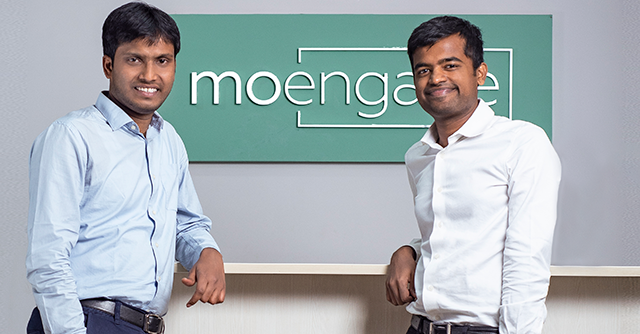
Raviteja Dodda, MoEngage’s co-founder and chief executive, said the company is expanding its use of AI agents to improve efficiency across marketing workflows. The goal is to move beyond manual campaign management and toward automated, intelligence-led engagement.
At the same time, MoEngage is broadening who its product serves. While customer engagement has traditionally centered on marketing teams, Dodda believes product and engineering groups are just as critical.
Those teams also need to understand user behavior, data patterns, and engagement signals. By bundling analytics and transactional messaging into a wider platform, MoEngage wants to become a core system for multiple functions inside large organizations.
This expansion strategy is expected to lift average contract values over time. It also opens the door to a much larger addressable market, especially among global enterprises that want a unified view of customer data and engagement.
Part of the MoEngage funding will also support strategic acquisitions. The company is actively looking at opportunities in the U.S. and Europe, with a focus on software businesses that complement its platform or speed up market expansion.
Small AI-focused teams are another target. Acquiring niche talent and technology could help MoEngage strengthen its intelligence layer without slowing product development.
Geographically, the company already has a balanced revenue mix. More than 30 percent of its revenue comes from North America. Around 25 percent is generated across Europe and the Middle East. The remaining 45 percent comes from India and Southeast Asia.
That global footprint reflects a strategy that blends international reach with an India-based operating model. According to investors, this has become one of MoEngage’s competitive advantages.
Bhavin Turakhia, co-founder and chief executive of fintech firm Zeta and a MoEngage customer, said the platform has helped improve onboarding, activation, and cross-sell across key customer journeys. He credited its analytics and messaging tools with driving measurable gains.
The secondary-heavy nature of the latest raise highlights MoEngage’s late-stage position. Rather than chasing growth at all costs or rushing toward an IPO, the company is using liquidity events to reward early stakeholders while staying flexible.
Dodda said the structure removes pressure to go public before the business is ready. While an IPO remains a goal, the timeline is not fixed. Market conditions and internal priorities will shape that decision.
Financially, MoEngage is nearing an important milestone. The company expects to turn EBITDA positive this quarter and is targeting compound annual growth of about 35 percent over the next three years.
Some early investors have now exited completely. Ventureast, which backed MoEngage in 2018, is one of them. The firm recorded roughly a ten-times return on its investment on a blended basis, according to partner Vinay Rao.
Rao noted that many global customer engagement companies operate with cost structures built for the U.S. market. MoEngage, by contrast, has retained a largely India-based cost base, allowing it to compete aggressively overseas while scaling efficiently.
With this latest transaction, MoEngage has raised around $307 million in primary funding to date. Investment bank Avendus advised the company on the deal.
For investors, the message is clear. MoEngage funding is no longer just about growth potential. It is about durability, disciplined expansion, and building a global SaaS company that can choose its own timing for the public markets.