Motional’s shift toward a unified AI backbone marked a decisive break from how its autonomous driving system had been built in the past. Instead of relying on many isolated machine learning models stitched together with rules-based logic, the company began searching for a way to merge these components into a single end-to-end architecture.
The goal was not to discard everything that already worked, but to reorganize it around a stronger core. Motional ultimately chose to keep its smaller, specialized models in place for developers while allowing a larger foundation model to handle holistic learning and decision-making. According to company leadership, this approach delivers flexibility without sacrificing scale.
Laura Major, Motional’s president and chief executive officer, has described this balance as essential to the company’s survival and future growth. By unifying intelligence under one backbone, the system can learn patterns across environments instead of reacting only to predefined rules. At the same time, developers still have access to smaller models that allow for transparency, testing, and targeted improvements. This dual structure, Major explained, gives Motional the best of both worlds at a moment when the industry is rapidly evolving.
The importance of this architectural change becomes clear when considering expansion beyond a single city. Generalization has long been one of the hardest challenges in autonomous driving. A system trained extensively in one urban environment often struggles when it encounters unfamiliar infrastructure elsewhere.
Traffic signals vary by region. Road markings differ. Driving culture itself changes from city to city. Under Motional’s previous approach, each of these differences required significant re-analysis and engineering effort. The new AI-first design reduces that burden by allowing the system to learn from data rather than rely on rigid assumptions.
Major has emphasized that this capability directly affects cost as well as speed. Instead of rebuilding logic for every new market, Motional can collect localized data, retrain the model, and deploy safely without starting from zero. The system does not need to be told explicitly how every traffic light works. It learns those differences through exposure and training. Over time, this process lowers deployment costs and makes global scale more realistic rather than theoretical.
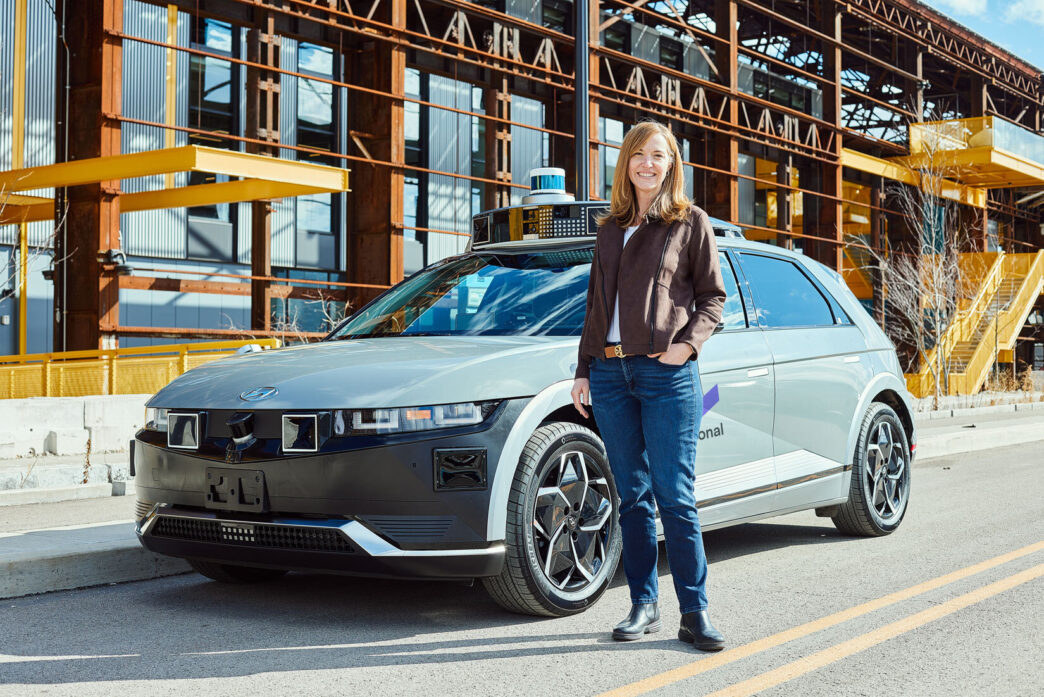
That promise of progress was evident during a recent autonomous drive in Las Vegas. While a single demonstration cannot fully validate a self-driving system, it can reveal meaningful differences compared to earlier iterations. The ride took place in a Hyundai Ioniq 5 equipped with Motional’s latest software. The vehicle navigated away from Las Vegas Boulevard and entered the busy pickup and drop-off zone at the Aria Hotel, an area known for congestion, pedestrians, and unpredictable movement.
These hotel frontage zones are notoriously difficult for autonomous systems. Vehicles must negotiate double-parked cars, taxis loading passengers, ride-hailing pickups, pedestrians crossing unpredictably, and obstacles placed for crowd control. In this case, the robotaxi handled the environment cautiously but confidently.
It nudged its way around a stopped taxi, adjusted lanes, and threaded through tight gaps while maintaining steady progress. The scene included dozens of people, large decorative planters, and constant vehicle movement, yet the system remained composed throughout.
This represented a clear departure from Motional’s earlier operations in Las Vegas. In previous deployments, the company worked with Lyft to offer rides where vehicles could drive autonomously only during certain portions of a trip. Parking lots, hotel entrances, and crowded pickup areas were excluded from autonomous control.
A human safety operator, always seated behind the wheel, would take over in those complex zones to ensure safe navigation. The new approach expands autonomous capability into spaces that were once considered off limits.
Despite the progress, Motional does not claim the system is finished. Some in-vehicle graphics shown to riders are still under development, and refinement continues. During the demonstration, the vehicle took extra time when maneuvering around a double-parked delivery van, choosing caution over speed. While this conservative behavior may feel slower than a human driver, it reflects a deliberate emphasis on safety. Importantly, there was no disengagement during the ride. The safety operator did not need to intervene at any point.
Major remains confident that these characteristics signal maturity rather than limitation. She argues that safe and cost-effective deployment matters more than aggressive driving behavior. From her perspective, Hyundai’s long-term commitment reinforces that mindset. As Motional’s majority owner, Hyundai Motor Group continues to support the company’s autonomous ambitions even after years of heavy investment and restructuring. That backing allows Motional to focus on building durable technology rather than chasing short-term wins.
Looking ahead, Major frames robotaxis as only the first step. The broader vision extends beyond fleets operating in select cities. The ultimate goal is to bring Level 4 autonomy into personal vehicles, where the system handles all driving without expecting human intervention. Robotaxis serve as the proving ground for that ambition. They generate dense real-world data, operate in demanding environments, and face constant variability. Each successful deployment strengthens the case for wider adoption.
For Motional, the integration of smaller models into a single AI backbone is more than a technical refinement. It is the foundation of a renewed strategy built around adaptability, efficiency, and scale. The company’s experience in Las Vegas suggests that this approach is already unlocking capabilities that were previously out of reach. While challenges remain, the progress reflects a clearer path forward than Motional had before its reset.
The story now is less about missed timelines and more about rebuilding with sharper assumptions. By centering autonomy around learning rather than rules, Motional is positioning itself for a future where driverless systems must operate safely across cities, cultures, and conditions. If the approach continues to deliver, robotaxis may prove to be the gateway to a much broader transformation in how people experience everyday driving.