

Wing drone delivery Walmart expansion marks a major acceleration in commercial drone logistics across the United States as the Alphabet-backed company deepens its partnership with Walmart and prepares to bring aerial delivery to another 150 stores. The move signals rising consumer demand for fast, low-cost delivery and highlights how drones are shifting from pilot programs into everyday retail operations. As more shoppers turn to on-demand fulfillment, Wing is positioning itself as a core logistics layer inside Walmart’s ecosystem.
Wing, which operates under Alphabet, has spent years refining drone delivery technology. Now, the company is translating that technical progress into large-scale commercial growth. The newly announced expansion will roll out throughout this year and extend into 2027, building on existing drone delivery operations in Dallas-Fort Worth and Atlanta. According to Wing leadership, customer adoption has reached levels that justify rapid expansion across new markets.
The Wing drone delivery Walmart partnership has become the company’s primary route to commercial scale. While Wing maintains a delivery relationship with DoorDash, Walmart remains its most important operational partner. By embedding drone services directly at Walmart locations, Wing can tap into high daily order volumes while keeping fulfillment costs predictable and tightly controlled.
Customer usage data underscores why Wing is scaling so aggressively. The company says its top quarter of users place drone orders roughly three times per week. Those orders often include everyday grocery staples rather than novelty purchases. Eggs, ground beef, tomatoes, avocados, limes, Lunchables, and snack foods like Takis dominate order lists. This behavior suggests drones are becoming part of routine household shopping rather than an occasional convenience.
The upcoming 150-store expansion follows earlier plans shared in mid-2025 to enter Houston, Orlando, Tampa, and Charlotte. Houston is scheduled to go live on January 15, marking the next major step in Wing’s regional rollout. Once the full expansion is complete, Wing will operate from more than 270 Walmart stores nationwide, reaching cities such as Los Angeles, St. Louis, Cincinnati, and Miami and serving close to 10 percent of the U.S. population.
This scale firmly places Wing beyond experimental status. The company began as a moonshot inside Google X, where drone delivery was once considered a futuristic concept. Today, the business is focused on execution, density, and economics. Its leadership views volume as the engine that powers long-term sustainability, making rapid store expansion a strategic necessity.
The relationship between Wing and Walmart began in 2023 with a small pilot program. That initial test involved two stores in the Dallas metro area and served around 60,000 households. As results proved promising, the program expanded to 18 Walmart Supercenters across Dallas-Fort Worth and later extended into the Atlanta market. Each phase delivered operational data that helped refine launch playbooks and customer onboarding.
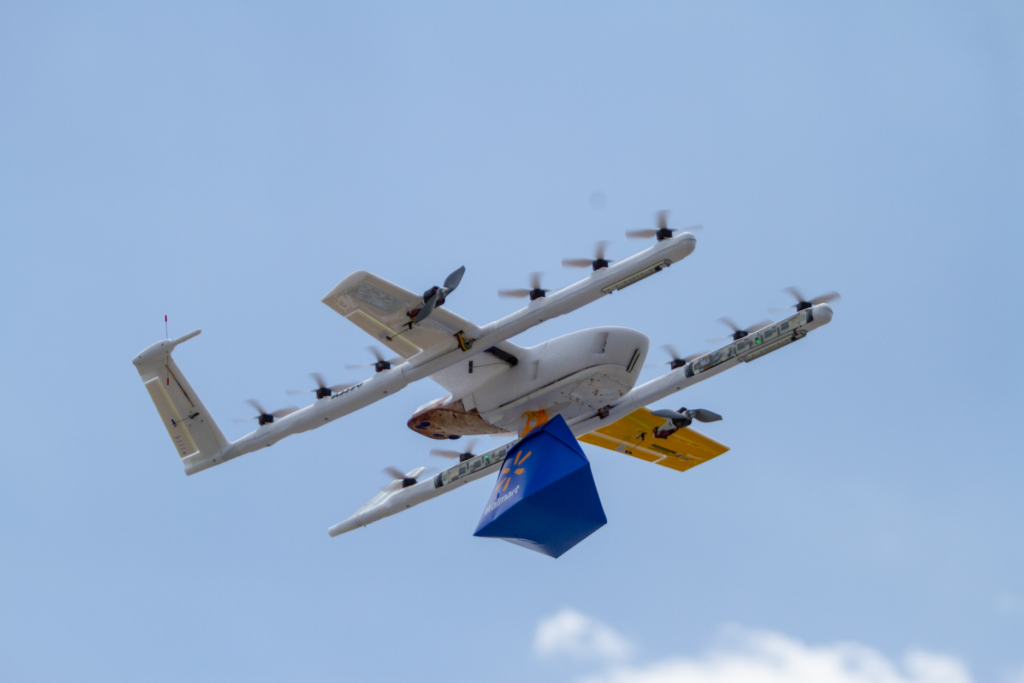
Wing’s operational strategy continues to evolve alongside the expansion. The company recently completed its first commercial flights using a larger aircraft capable of carrying payloads up to five pounds. This upgrade allows for a wider range of grocery items per order, increasing average basket size while preserving delivery speed. Still, Wing remains focused on co-locating its drone infrastructure directly at Walmart sites to reduce friction and simplify logistics.
Scaling efficiently remains the core challenge. Wing plans to test clustered store launches, opening multiple locations within a single region at the same time. This approach helped accelerate adoption in Atlanta last year when six stores launched together. Regional density allows drones to operate more frequently, improves cost efficiency, and builds faster customer awareness through local visibility.
Profitability remains undisclosed, but Wing leadership has been clear about priorities. The company is focused on expansion, usage growth, and operational learning rather than short-term margins. Executives emphasize that volume drives the flywheel, with higher order frequency improving economics over time. As drone delivery shifts from novelty to necessity, this scale-first mindset mirrors early strategies used by successful last-mile delivery platforms.
The Wing drone delivery Walmart expansion also reflects broader changes in retail logistics. Consumers increasingly expect fast delivery without premium pricing, while retailers seek alternatives to labor-intensive fulfillment models. Drones offer a compelling solution for short-range deliveries, especially in suburban areas where road congestion and labor costs challenge traditional delivery methods.
As Wing pushes into new markets, its success could reshape how large retailers think about last-mile logistics. Walmart’s willingness to expand drone delivery at this scale sends a strong signal to the industry. If customer adoption continues at current levels, drone delivery could soon become a standard option alongside curbside pickup and same-day shipping.
The next two years will be critical. Wing must prove that its operational model can scale reliably across hundreds of stores while maintaining safety, speed, and customer satisfaction. If it succeeds, the partnership with Walmart may become a blueprint for how drone delivery integrates into mainstream retail across the United States.